
You don't necessarily need to buy a camera to start astrophotography. The bigger question is whether the DSLR or mirrorless camera already sitting in your closet is good enough, or whether it's time to move to a dedicated astronomy camera. This guide covers both sides: what to use if you're starting with gear you already own, and what to look for if you're buying dedicated equipment.
Do you actually need a dedicated astro camera?
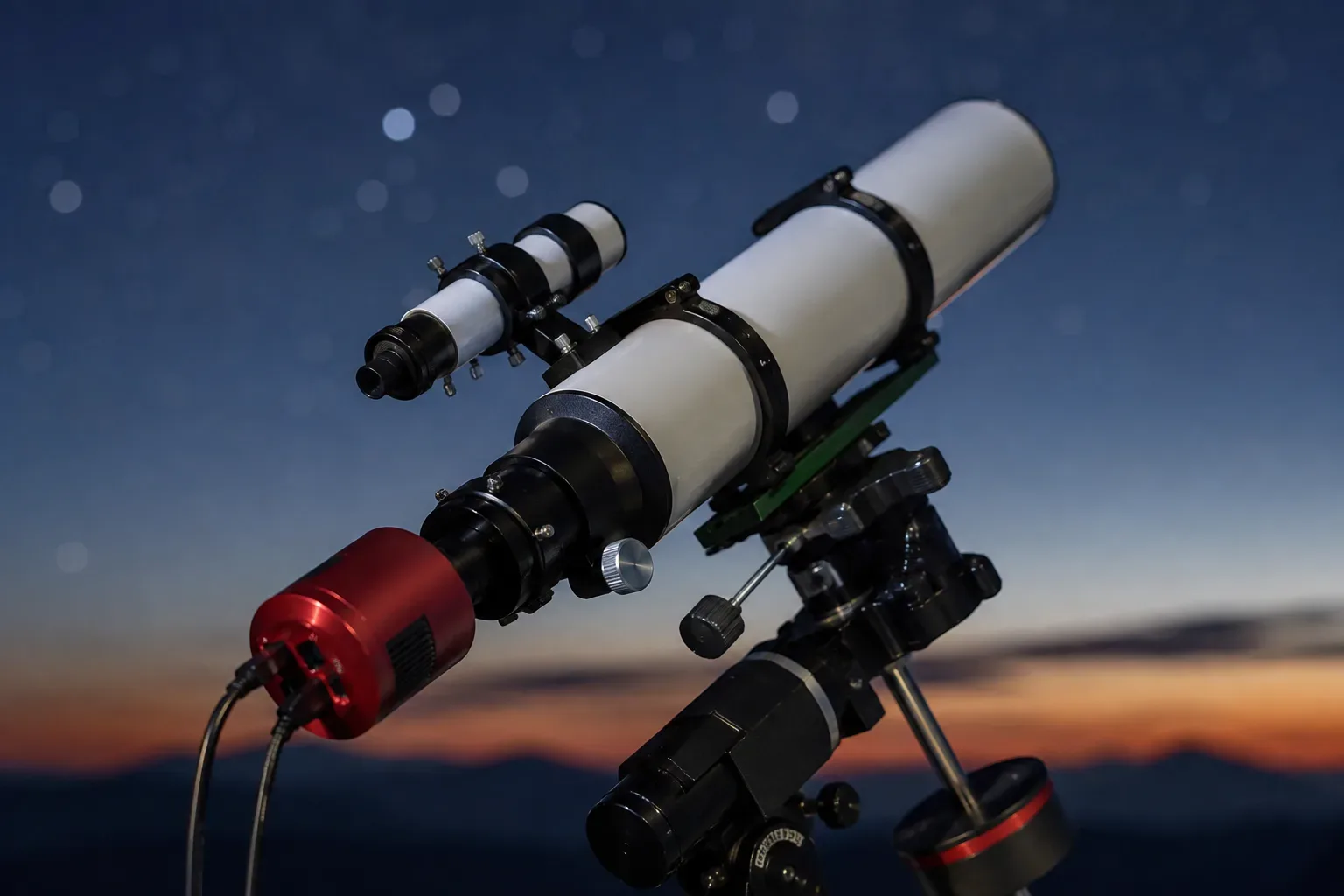
A DSLR or mirrorless camera is often the easiest and most flexible way to begin, especially if you already own one. It's a perfectly valid starting point for Milky Way shots, wide-field star trails, and even simple deep-sky targets through a telescope. The tradeoff shows up on longer, more demanding exposures: a DSLR sensor heats up as you shoot, and there's no way to precisely regulate that temperature, which adds thermal noise to long exposures.
A cooled dedicated astronomy camera solves that specific problem. It holds the sensor at a controlled temperature all night with a built-in thermoelectric cooler, which makes calibration easier and keeps thermal noise down on exposures that run for minutes at a time. Modern CMOS sensor technology has also brought capable cooled cameras below $1,000, which puts them within reach of casual and beginner-level astrophotographers, not just people with a serious budget.
| Type | Typical Cost | Cooling | Best For | Learning Curve |
|---|---|---|---|---|
| DSLR/Mirrorless (already owned) | $0 if already owned | None, sensor warms during use | Getting started without new gear, Milky Way, wide-field | Low, most people already know the camera |
| Dedicated cooled astro camera | Under $1,000 for entry models | TEC-cooled, consistent sensor temperature | Long-exposure deep-sky imaging | Higher, new software/workflow to learn |
The honest answer for most beginners: shoot with what you have first. If you find yourself wanting longer exposures, less noise, and better deep-sky results than your DSLR can deliver, that's the point where a dedicated camera starts paying for itself, not before.
Recommended starting settings
| Target Type | ISO Range | Exposure Time | Aperture |
|---|---|---|---|
| Milky Way (wide lens) | 1600-3200 | 10-20 seconds (untracked) | Widest available, f/2.8 or faster if possible |
| Moon | 100-400 | 1/125s-1/250s | f/8-f/11 |
| Deep-sky (tracked) | 800-1600 (DSLR) or camera-dependent (dedicated) | 60-300 seconds per sub-exposure | Telescope's native focal ratio |
These are starting points, not fixed rules. Every camera, lens, and sky condition is a little different, expect to adjust from here after your first few sessions.
Mono or color: what's the difference?
A color camera captures a usable image in a single shot, which is why almost every beginner starts there. A monochrome camera captures no color data on its own; it has to be shot through separate red, green, blue, or narrowband filters and combined in software afterward. That workflow produces excellent results in experienced hands, but it adds real cost (filters, a filter wheel) and complexity that most people don't need for their first year of astrophotography.
When does a dedicated camera become worth it?
If you're finding that your DSLR's noise floor is limiting how much detail you can pull out of faint targets, or you're outgrowing simple wide-field shots and want to go deeper into nebulae and galaxies, that's the point to look at a dedicated camera. ZWO's ASI533MC Pro is a representative entry point: a 9-megapixel color sensor with cooling down to 35°C below ambient temperature, the kind of spec that starts to matter once thermal noise on a DSLR becomes the limiting factor in your images rather than your technique.
Frequently asked questions
What's the best camera for beginners in astrophotography? The DSLR or mirrorless camera you already own, if you have one. It's a genuinely capable starting point before investing in dedicated gear.
Do I need a dedicated astronomy camera to get started, or is a DSLR enough? A DSLR is enough to start, especially for Milky Way and wide-field shots. A dedicated cooled camera becomes worthwhile once you're doing longer deep-sky exposures and want less thermal noise.
What starting camera settings work for Milky Way photography? ISO 1600-3200, a 10-20 second exposure, and the widest aperture your lens allows, typically f/2.8 or faster.
Should I buy a color or monochrome astronomy camera first? Color. A color sensor gives you a usable image immediately, while monochrome requires separate filters and a more advanced processing workflow.
Does a full-frame sensor give a real advantage over APS-C for astrophotography? A larger sensor generally gathers more light and gives a wider field of view at a given focal length, which helps with faint, extended targets, but it's a secondary factor compared to cooling and exposure time for image quality.
Sources
- [S001] Astrobackyard : DSLR vs Dedicated Astronomy Camera for Astrophotography
- [S002] Agena Astro : ZWO ASI533MC Pro