
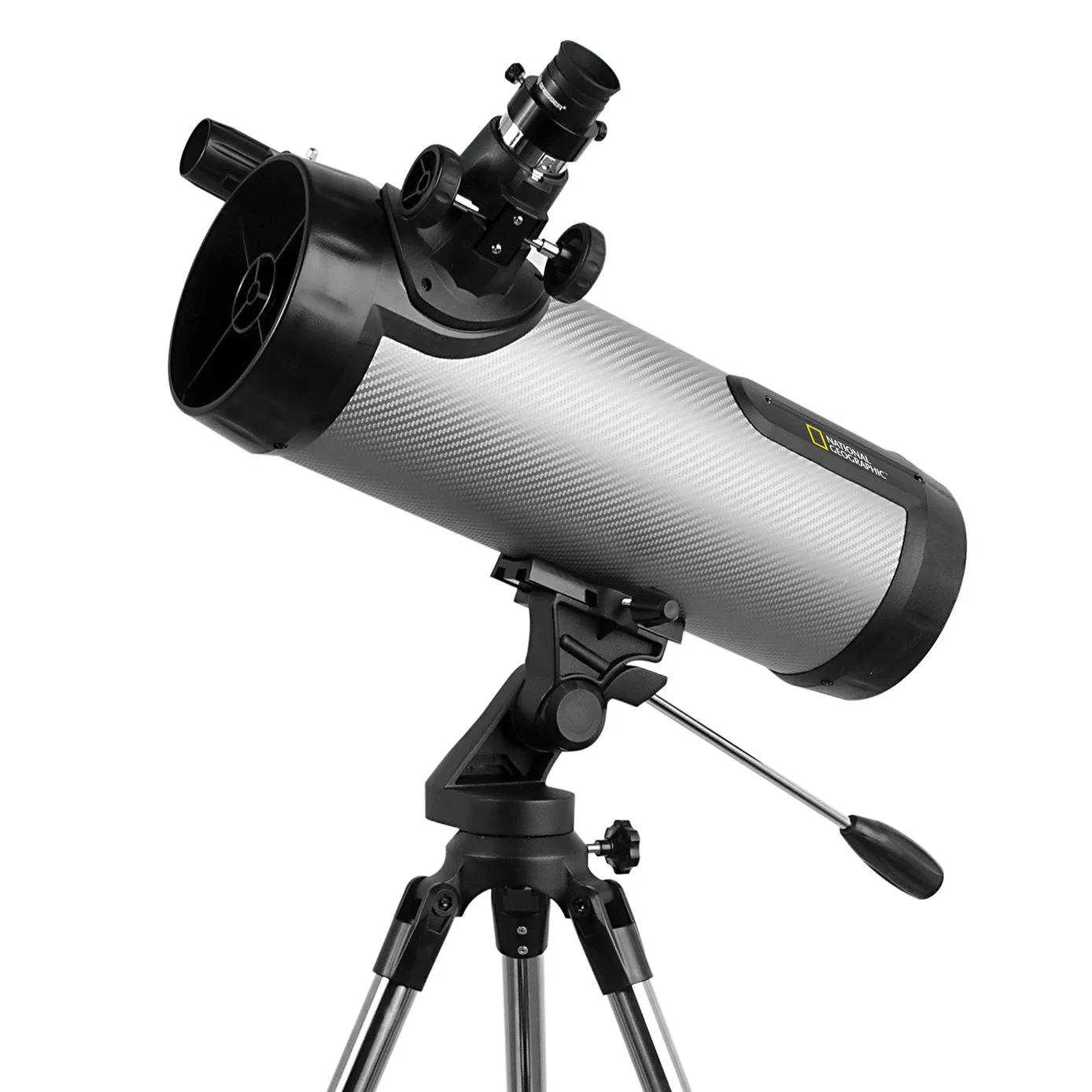
- Key Facts
- Rating6.8/10
- Why this pickAt $119.99 this is a real 114mm Newtonian reflector, not a toy-grade refractor with an inflated magnification number on the box, it's confirmed in stock, and the simple manual altazimuth mount is easy enough for a parent to help a child point and track by hand without a computer to learn first.
Pros
- 114mm aperture shows real detail on the Moon and bright planets, not a blur
- Low price means less stress over a first-timer's inevitable bumps and drops
- Manual altazimuth mount is intuitive for a child to point and follow
Cons
- No motorized tracking, an adult may need to help re-center fast-moving targets
- Included eyepieces are entry-level and often get upgraded later
- National Geographic branding adds no engineering value over the same-spec Bresser/Explore Scientific model
Most "kids' telescopes" sold in big-box stores are toys wearing a telescope's clothes. They advertise magnification numbers like 400x or 700x on the box, and a child who unwraps one on Christmas morning is looking through a shaky, blurry eyepiece by New Year's. This guide is about the other kind: real, working telescopes a child can actually use, sized and priced for a first purchase rather than a serious hobbyist's second or third scope.
Why the number on the box lies to you
Every telescope has a real ceiling on how much magnification it can usefully deliver, and that ceiling comes from its aperture (the diameter of the main lens or mirror), not from whatever multiplier a manufacturer prints on the packaging. Astronomy educators put that practical limit at roughly 50x for every inch of aperture, which works out to an exit pupil around 0.5mm. Push past it and the image doesn't get more detailed, it just gets dimmer and mushier. A 70mm telescope (a common beginner and kids' size) has just under 2.8 inches of aperture, so its real usable ceiling sits around 140x, not the 400x or 700x often printed on the box. Experienced planetary observers typically stay lower still, around 20x to 30x per inch, because that's where images actually look sharpest.
That gap between the marketing number and the optical reality is the single biggest reason a first telescope disappoints a child within weeks. A toy scope cranked to its advertised maximum shows a dim, shaking blob; the same scope at a sane, aperture-appropriate magnification shows Saturn's rings or the craters on the Moon clearly.
Signs a "telescope" is really a toy
| Warning sign | Why it's misleading |
|---|---|
| Magnification numbers over 300x printed prominently on the box | No small-aperture telescope can usefully deliver this, the real ceiling is set by aperture, around 50x per inch |
| No stated aperture (lens/mirror diameter) anywhere on the packaging | Aperture, not magnification, determines how much detail and light the telescope can actually gather |
| All-plastic optical tube and mount | Flexes and vibrates at any real magnification, making the view unusable even if the optics themselves are decent |
| Eyepieces below 4mm focal length included as standard | Forces the telescope past its usable magnification limit by design, guaranteeing a poor first impression |
What actually works for a first telescope
Two real, current entry-level products illustrate the difference between a toy and a working beginner instrument. The National Geographic RT70400 is a 70mm refractor on a simple pan-handle mount, sold through Explore Scientific. It's a straightforward point-and-look design with no fine adjustments to fight. A step up for a family ready to see fainter targets is the National Geographic NG114mm, a 114mm Newtonian reflector with a 500mm focal length (f/4.4) on an equatorial mount, which ships with two Plossl eyepieces, a red dot finder, and a star map, at roughly $210.
At the budget end, the Gskyer AZ70400, a 70mm, 400mm-focal-length refractor that regularly sells for under $100, is one of the most-reviewed telescopes in this price bracket. Reviewers consistently note it sets up in about five minutes with no tools, which matters for a parent with no astronomy background, but they're equally consistent that it won't deliver the crisp views of a larger-aperture instrument, and a child using it will need an adult's patience during the first few sessions. Neither Gskyer nor National Geographic's telescopes ship with National Geographic's parent company or Gskyer's own storefront as our current retail partner in the US; National Geographic's telescopes are sold through Explore Scientific, one of our two current recommended merchants, while Gskyer isn't currently carried by either partner we track.
Best telescope for kids by age
| Age range | Recommended type | Budget | Watch for |
|---|---|---|---|
| 5–7 | Small refractor (60–70mm), simple alt-azimuth mount | Under $100 | Set expectations low, the Moon and bright planets only, with adult help required |
| 8–10 | 70mm refractor or small tabletop reflector | $100–$220 | Look for a stated aperture and a metal (not all-plastic) focuser |
| 11+ | 114mm reflector or entry Dobsonian | $200–$400 | A child this age can usually handle basic setup and simple star-hopping alone |
How much should a kids' telescope cost?
Based on the two real product tiers above, a telescope that won't disappoint a child within a month realistically starts around $100 (Gskyer AZ70400-class) and moves into genuinely capable territory around $200–$220 (National Geographic NG114mm-class). Anything advertised well below $50 with triple-digit magnification claims printed across the box is very likely a toy, regardless of brand.
What can a child actually see?
With a 70mm refractor, a child can expect sharp views of the Moon's craters, Saturn's rings as a distinct shape (not just a blur), Jupiter's four brightest moons as points of light, and Jupiter's cloud bands under good conditions. Stepping up to a 114mm reflector adds brighter deep-sky targets, star clusters and, under dark skies, the Orion Nebula, into range. None of these instruments will produce the vivid, saturated-color images seen in space telescope photography; managing that expectation before the first night outside prevents a lot of disappointment.
Refractor or small Dobson for a first scope?
Both work for a child, and the choice mostly comes down to how much adult supervision is realistic. A small refractor like the RT70400 has no mirrors to align and nothing to adjust beyond pointing it, which suits a younger child or a parent who wants zero maintenance. A compact reflector adds a bit more light-gathering power for the same footprint, at the cost of needing occasional mirror alignment (collimation), usually still a task for the adult, not the child, on entry-level models. For a deeper look at how these two designs differ beyond the kids' segment, see our full comparison of Dobsonian telescopes for beginners.
Turning a gift into a habit
A telescope that gets used past the first week usually has three things going for it: it lives somewhere easy to grab (not packed away after the first session), the child has been shown one or two specific, findable targets rather than told to "go look at stars," and a parent sits through the first two or three sessions rather than handing it over solo. None of that requires a bigger budget, it requires treating the first few nights as a shared activity rather than a one-time unboxing.