
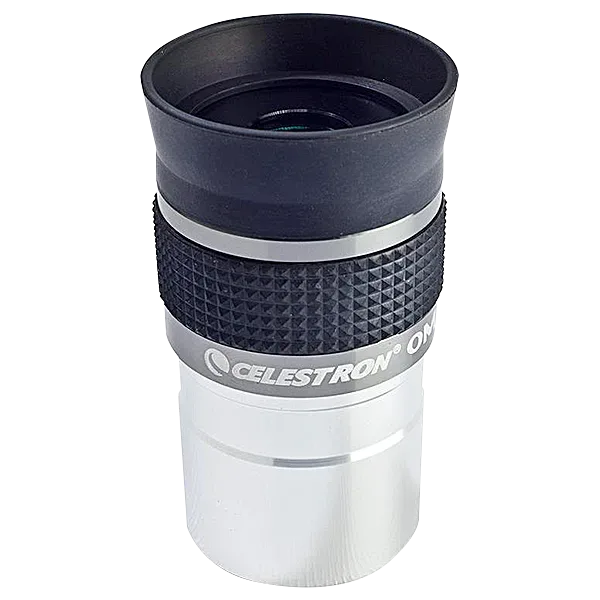
- Key Facts
- Rating7.8/10
- Why this pickA 15mm focal length sits in the mid-power range that works well on most beginner and mid-range telescopes for both planets and brighter deep-sky objects, and the 52-degree apparent field is wide enough to feel comfortable without the added cost of a wide-field design.
Pros
- Low cost relative to premium wide-field eyepieces
- 1.25" barrel fits the vast majority of beginner and mid-range telescopes
- Mid-power focal length usable on both planets and brighter deep-sky targets
Cons
- 52-degree field feels narrower than premium wide-field eyepieces once you've tried one
- Plossl design shows more edge-of-field softness than higher-end optical designs
- Only one focal length, most observers eventually want two or three
The eyepiece decides as much of your view as the telescope's optical tube does. The single eyepiece that ships with most starter scopes covers one magnification and one field of view; everything else on the sky needs a different one. This guide covers how magnification actually works, what field of view and eye relief mean in practice, and which eyepieces to buy first.
How magnification actually works
Magnification is the telescope's focal length divided by the eyepiece's focal length. A 25mm eyepiece on a telescope with a 2000mm focal length gives 2000 ÷ 25 = 80x. Swap in a 10mm eyepiece on the same telescope and you get 200x. The eyepiece's printed focal length in millimeters is the number that matters, not a magnification claim printed on the box, a "wide" eyepiece and a "narrow" one at the same focal length still produce identical magnification on the same telescope.
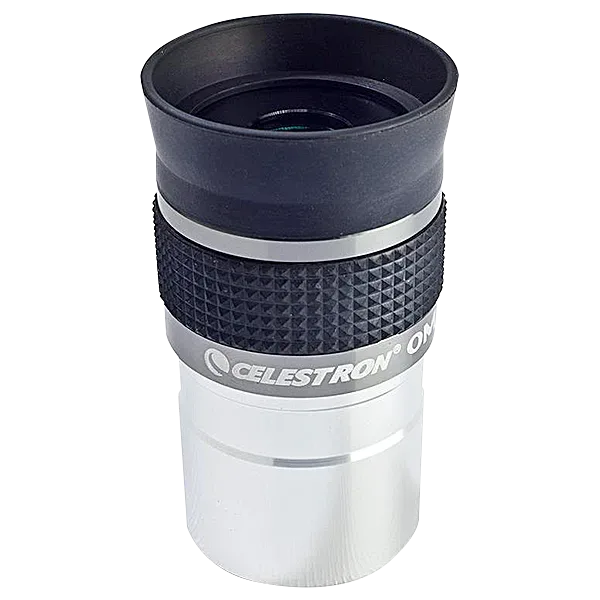
Field of view: apparent vs true
Apparent field of view (AFOV) is how wide the view looks to your eye, measured in degrees; most standard eyepieces sit around 40-50 degrees. True field of view is the actual patch of sky you're seeing, and it's calculated by dividing the AFOV by the magnification. A 20mm eyepiece with a 50-degree AFOV on a 2000mm telescope gives 100x, so the true field of view works out to 50 ÷ 100 = 0.5 degrees, roughly the width of the full Moon. That distinction matters when picking an eyepiece for a star cluster versus a single planet: a wide true field fits more sky in, while a narrow one concentrates detail on a small target.
Eye relief matters more if you wear glasses
Eye relief is the distance you can hold your eye from the eyepiece lens and still see the whole field of view. Eyeglass wearers typically need 15-20mm of eye relief to see the full picture without the image cutting off at the edges. In most traditional eyepiece designs, shorter focal lengths come with shorter eye relief, which is worth checking before buying a high-magnification eyepiece if you observe with glasses on.
Which eyepieces to buy first
| Focal length | Use | Field of view | Typical budget |
|---|---|---|---|
| 25-32mm | Wide views, star clusters, finding targets | Wide | $30-60 |
| 15-20mm | General deep-sky, nebulae, galaxies | Medium | $40-90 |
| 6-10mm | Planetary and lunar detail, high magnification | Narrow | $50-120 |
One eyepiece from the wide end and one from the narrow end covers most of what a beginner observes in the first year, a low-power option for finding and framing objects, and a high-power one for planets and the Moon.
Does a Barlow lens replace buying more eyepieces?
A Barlow lens sits between the eyepiece and the focuser and contains a lens element that extends the telescope's effective focal length, most commonly by a factor of two. A 2x Barlow turns a 1000mm telescope into an effective 2000mm one, so the same eyepiece produces double the magnification, pushed to an extreme, a 6mm eyepiece through a 2x Barlow on that setup would exceed 330x. A Barlow does not replace a full eyepiece set, since it only doubles what you already own rather than adding new fields of view, but it is a cheap way to add high-power options without buying another eyepiece outright.
1.25 inch or 2 inch: check compatibility before buying
| Barrel size | Advantages | Telescope compatibility |
|---|---|---|
| 1.25 inch | Cheaper, lighter, widest eyepiece selection on the market | Fits nearly every beginner and mid-range telescope |
| 2 inch | Wider true field of view at low power, better for large deep-sky objects | Requires a 2-inch focuser, common on larger Dobsonians and some refractors, not universal |
Check your telescope's focuser size before buying a 2-inch eyepiece. Most beginner and mid-range telescopes only accept 1.25-inch eyepieces, and a 2-inch eyepiece that doesn't fit is not a returnable mistake worth risking.
Budget vs premium: what the price difference buys
Budget eyepieces from brands like Svbony get you into observing without a large outlay, and for a first eyepiece upgrade they are a reasonable starting point, see our Svbony brand review for what that gets you. Premium eyepieces from a brand like Tele Vue, covered in our Tele Vue brand review, improve edge sharpness, wider apparent fields, and more comfortable eye relief, which shows up most on close-up planetary views where every bit of contrast counts. The difference is real, but it is not always the first upgrade worth making, a wider selection of focal lengths, even budget ones, usually improves your observing more than one expensive eyepiece.