
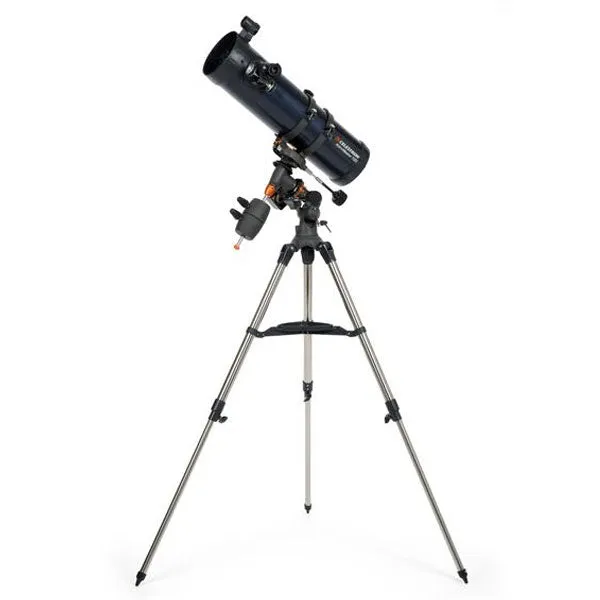
- Key Facts
- Rating7.8/10
- Why this pick130mm of aperture is a real step up from the 70-90mm scopes marketed at kids, and the motor drive on the RA axis removes the single most frustrating part of a first equatorial mount: constantly nudging the slow-motion controls by hand to keep an object centered.
Pros
- Motor drive removes manual RA tracking, the biggest pain point of a plain equatorial mount
- 130mm aperture is enough to show real detail on planets and brighter deep-sky targets
- Same optical design Celestron has sold for years, a proven, not experimental, choice
Cons
- Costs about $80–100 more than the non-motorized 130EQ
- Motor drive tracks one axis only, no full GoTo automation
- Equatorial mount setup and polar alignment take longer than an alt-azimuth mount
An adult buying their own first telescope has different needs than a parent buying one for a kid, even though a lot of "beginner telescope" content treats the two the same. Kids' telescopes prioritize being lightweight and hard to damage. An adult buyer usually wants more aperture, a mount built for repeated fine adjustment, and optics that hold up past the first week of curiosity.
Adult telescope vs. kids telescope
| Criteria | Adult telescope | Kids telescope |
|---|---|---|
| Size/weight | Larger aperture (100mm+), heavier tube | Smaller, lighter, easier for a child to carry |
| Durability | Metal mount components, built for repeated fine adjustment | Simplified mount, fewer fragile parts |
| Optical quality | Sharper views, more usable magnification | Adequate for Moon/bright planets, limited beyond that |
| Price | $239-$799 typical | Often under $150 |
If you already have a kids' telescope sitting in a closet somewhere, that's usually a sign it's time to step up rather than settle for the same category again. The table above isn't just a spec comparison, it maps directly onto how long a telescope stays useful. A kids' model tops out once a child's curiosity outpaces its optics, usually within a season or two; an adult-oriented model's larger aperture and sturdier mount are what let it keep showing new detail years after the first unboxing.
What to actually look for
A Dobsonian reflector scales up well for adult use: the rocker-box mount needs no separate tripod and stays stable during use, an advantage that only matters more as aperture (and weight) increases. That stability matters in a way that's easy to underestimate before you've used one, a bigger mirror gathers more light, but it also means more mass sitting on top of whatever's holding it up, and a wobble that's a minor annoyance on a small refractor becomes a real problem for keeping a faint object framed in the eyepiece on a large reflector. The rocker-box design sidesteps that by putting the weight low and wide instead of balanced on a tripod head.
If portability matters more to you than raw aperture, a mid-range refractor or a smartphone-guided model is worth considering instead. A refractor's sealed tube needs no mirror collimation and travels well in a car trunk, which matters if your only realistic viewing spot is a dark-sky site you have to drive to rather than a backyard.
One specific option worth naming: the Celestron StarSense Explorer LT 114AZ uses your phone's camera and an app to help you find targets without a full computerized GoTo system, and it currently lists at $239.95 on OPT Telescopes. It sits comfortably above the true entry-level tier without jumping into serious-hobbyist pricing, and it's a reasonable middle path for an adult who wants object-finding help but isn't ready to commit to learning a full GoTo hand controller.
Budget: where adult-serious starts
On OPT Telescopes, the entry lineup ($159–$229) is aimed at total newcomers of any age. The tier that suits a more committed adult buyer, including the SkyScanner and the 8-inch StarSense Explorer Dobsonian, runs $399 to $799. That jump buys more aperture and a sturdier mount, both of which matter more the longer you plan to keep using the telescope. Our own pick, the AstroMaster 130EQ-MD, sits between those two bands at $359.95, past the entry tier's optics but below the full mid-range Dobsonian price, which is exactly the gap an adult moving up from a toy-grade telescope but not yet ready for an 8-inch mirror tends to be shopping in.
Why the AstroMaster 130EQ-MD earns the pick
The 130mm aperture is the first thing that separates this scope from the 70-90mm models marketed at kids: more aperture means more light reaching the eyepiece, which translates directly into dimmer objects becoming visible and brighter ones showing finer detail. The second thing is the mount. A plain equatorial mount asks a beginner to manually turn a slow-motion control to compensate for Earth's rotation every minute or two, which gets old fast during a long planetary observing session. The CG-3 mount's motor drive on the right ascension axis does that job automatically, so the object stays framed without constant hand-cranking, the single change most likely to keep a first-time adult buyer actually using the telescope instead of shelving it after a few sessions. It isn't full GoTo automation (you still find and center the target yourself, the motor only tracks it once found), which is also why it costs roughly $80-100 less than a comparable GoTo-equipped model and keeps the learning curve closer to a standard equatorial mount than to a computerized system.
See adult-friendly telescopes at OPT Telescopes /go/opt-telescopes)
Is a GoTo (computerized) telescope worth it for an adult?
More than for a kid, arguably. An adult with the patience to work through a one-time alignment routine gets real value from a mount that then finds and tracks targets automatically, especially for planetary and deep-sky sessions that run long. If that alignment step still sounds like a hassle, a smartphone-guided model like the StarSense Explorer splits the difference: no separate alignment, just app-guided manual pointing.