
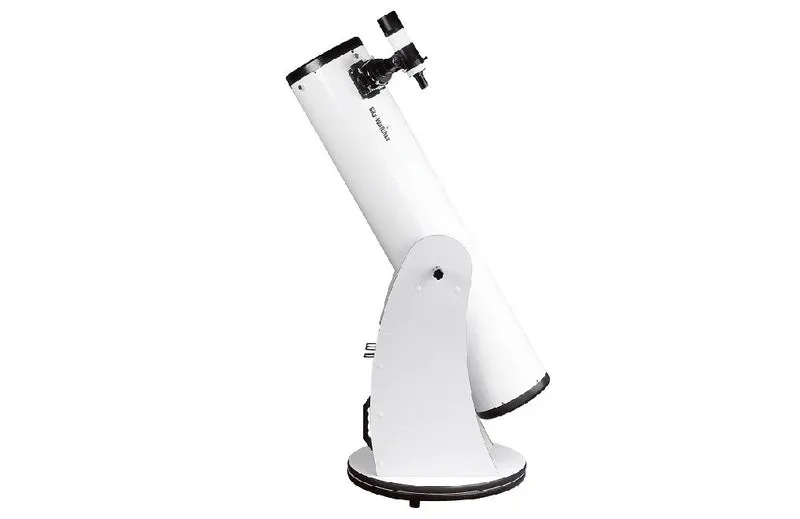
- Key Facts
- Rating8.3/10
- Why this pick200mm of aperture is large enough to resolve cloud bands on Jupiter and Saturn's rings sharply, while also pulling in enough light to show galaxies as more than a faint smudge, a genuine dual-purpose aperture that smaller scopes can't match.
Pros
- 8-inch aperture gathers far more light than typical beginner 70-114mm scopes
- Sharp enough for planetary detail, large enough for real deep-sky views
- No electronics or GoTo alignment routine to learn
Cons
- No automatic tracking or object-finding, manual push-to only, so finding faint galaxies takes practice
- Bulkier and heavier than tabletop models, needs floor space
- OPT lists it as special-order (Contact Us for Availability), not instant-checkout stock
If Saturn's rings are the reason you want a telescope, the good news is you don't need much aperture to see them. The less good news: what you'll actually see through the eyepiece looks nothing like the Hubble photos that got you interested in the first place. Here's what's realistic at each aperture, and which telescope shapes get you there fastest.
What you'll actually see, by object
| Object | Aperture needed | What it looks like |
|---|---|---|
| Saturn's rings | 70mm minimum, 100-130mm comfortable | A distinct disk-and-ring shape at 40-50x, thinner than usual in 2026 |
| Saturn's moons | 100mm+ | Titan reliably, up to 4-6 total (Rhea, Dione, Tethys, Enceladus, Mimas) |
| Jupiter's cloud bands | 70mm minimum | Visible parallel bands, easier to see than Saturn's due to Jupiter's larger apparent size |
| Jupiter's Galilean moons | Any telescope, even binoculars | Four bright points of light in a line, positions change night to night |
| Jupiter's Great Red Spot | Decent aperture + steady air | A visible reddish oval, not guaranteed every session |
At roughly 40-50x magnification, Saturn's rings separate cleanly from the planet's disk, a level of power a small 70mm refractor or a 100-130mm telescope both handle without strain. With a bit more aperture, the outer A ring reads visibly dimmer than the broader B ring inside it, and faint belts sometimes show on the ball of the planet itself, though nowhere near as clearly as Jupiter's.
One thing to know about Saturn in 2026 specifically
Saturn's rings are seen nearly edge-on from Earth this year, so they look thinner than the wide, dramatic tilt shown in most photos. It's still worth observing, but if your first view looks more like a thin line than a bold ring, that's the actual sky right now, not your telescope underperforming.
Jupiter is the easier planet to start with
A basic 70mm achromatic refractor already shows Jupiter's cloud bands, and the four Galilean moons (Io, Europa, Ganymede, Callisto) are visible in essentially any telescope, moving noticeably from night to night. Jupiter's disk is roughly six times the visible area of Saturn's near opposition, which is why its bands read more clearly than Saturn's fainter zones at the same aperture. Catching the Great Red Spot takes a bit more aperture and steadier atmospheric conditions, and it isn't visible on every session even with a good telescope.
Browse telescopes for planetary viewing at OPT Telescopes /go/opt-telescopes)
Which telescope type gets you there
A Dobsonian's large aperture-per-dollar makes it a strong general pick for both planets and fainter deep-sky targets like galaxies, without the added cost of a computerized mount. Our Dobsonian telescope guide covers specific aperture sizes in more depth. For a lighter, lower-maintenance option focused mainly on the Moon and planets, a refractor works well too; Celestron's lineup covers both approaches at several price points.
Setting realistic expectations before you buy
No amateur telescope, at any price, reproduces a NASA press photo. What you get instead is a small, genuinely detailed disk, Saturn's rings or Jupiter's bands rendered exactly as your eye and that specific telescope resolve them, which is a different kind of experience from looking at a picture. Buyers who go in expecting that tend to be far happier with an entry-level telescope than buyers expecting Hubble-quality color images.
Observing vs. photographing: two different goals
This guide is about looking through the eyepiece yourself. If the goal is capturing images of planets rather than observing them live, the equipment and technique are different enough to warrant a separate guide; see our best telescope for astrophotography breakdown instead.