
- Key Facts
- Rating7/10
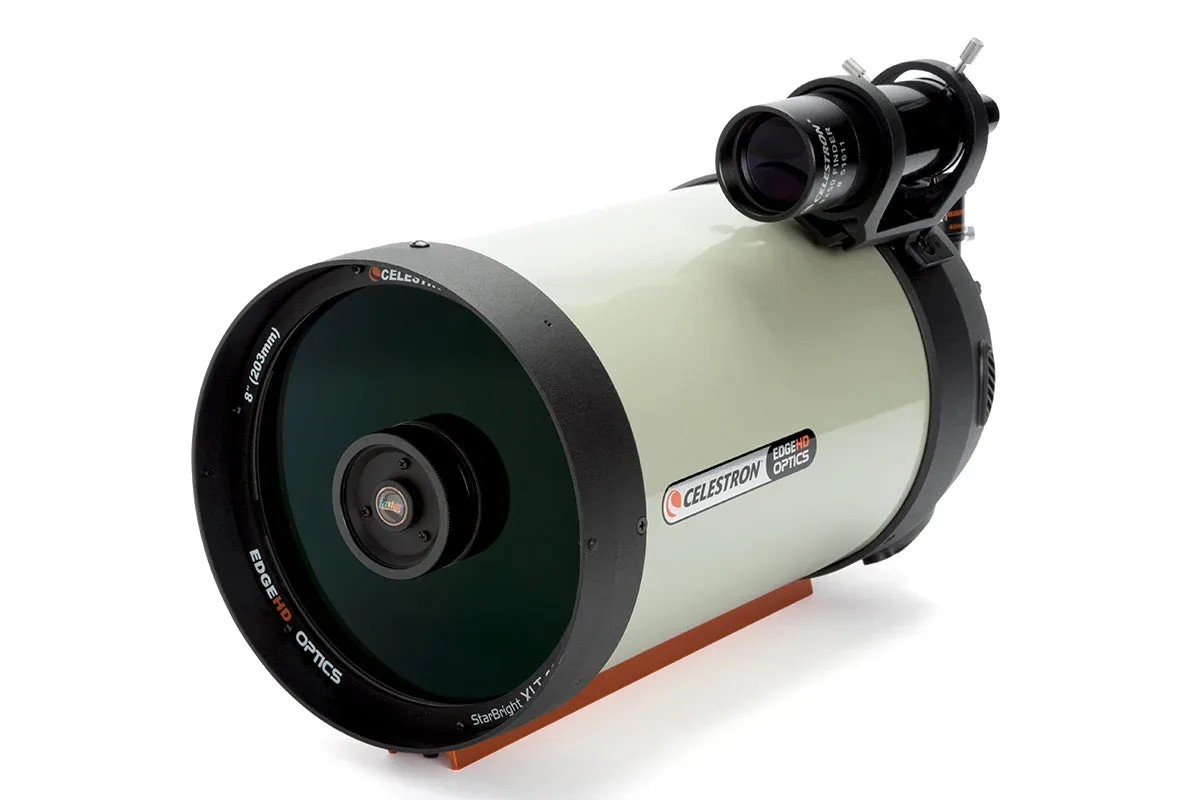
- Why this pickReal 8-inch aperture with EdgeHD optics specifically corrected for large-sensor imaging, confirmed in stock direct from Celestron, the tradeoff is a slower focal ratio and real weight versus a portable apo refractor.
Pros
- Real 8-inch aperture delivers far more magnification than a compact apo refractor
- EdgeHD optics correct field curvature specifically for imaging with large sensors
- Confirmed in stock direct from Celestron
Cons
- Slower native focal ratio (f/10) means longer exposure times than a fast apo refractor
- 6.35 kg tube alone needs a heavier, sturdier mount than a travel setup
- Confirmed low stock at the time of this check ("Only 6 left")
Choosing a telescope for astrophotography is a different decision than choosing one for visual observing. A telescope that gives beautiful views at the eyepiece can still be a frustrating imaging platform, and the reverse is also true. This guide is specifically about the tube and mount you point a camera through, not the telescope you'd pick to look through with your own eye.
Why a "good" visual telescope isn't automatically good for imaging
A camera sensor is far less forgiving than your eye. Coma, field curvature, and chromatic aberration that are barely noticeable visually show up clearly in a long-exposure photo, especially toward the edges of the frame. A telescope also needs to sit on a mount that can track the sky accurately for minutes at a time without the image drifting, which most basic beginner mounts aren't built to do. That's why a dedicated imaging setup usually looks different from a general-purpose visual telescope, even at a similar price.
Refractor or reflector: which is better for astrophotography?
| Design | Focal Ratio Range | Coma/Correction Needed | Portability | Typical Use |
|---|---|---|---|---|
| Apo refractor (e.g. RedCat 51) | f/4.9-f/6 typical | Flat field built into Petzval design | 1.77-2.38 kg, very portable | Wide-field deep-sky, portable/travel setups |
| SCT (e.g. EdgeHD 8) | f/10 native, f/7 with reducer | EdgeHD optics correct field curvature for large sensors | 6.35 kg tube alone | Higher-magnification deep-sky and planetary imaging |
Apochromatic (apo) refractors are the most common choice for wide-field deep-sky imaging. A good example is the William Optics RedCat 51: 51mm aperture, 250mm focal length, f/4.9, and a Petzval optical design that delivers a flat field without needing an add-on corrector. The whole optical tube weighs 1.77 kg, or 2.38 kg with rings and dovetail, light enough for a small travel mount.
Schmidt-Cassegrain telescopes (SCTs) take a different approach: more focal length and magnification in a compact tube, at the cost of a slower focal ratio and more weight. Celestron's EdgeHD 8 has an 8-inch aperture and 2032mm focal length (f/10 native, f/7 with an optional reducer), with optics specifically corrected to keep stars sharp across large sensors up to a 42mm image circle. The aluminum tube weighs 14 lb (6.35 kg).
Neither is objectively "better", they suit different targets. A fast apo refractor collects light quickly and covers a wide field, which is why it needs shorter exposures for the same result. A slower SCT like the EdgeHD gathers less light per second but delivers far more magnification, which matters more for smaller, brighter targets like galaxies and planetary nebulae than for large, faint nebulae.
What is focal ratio, and why does it matter here?
Focal ratio (the f/number) is focal length divided by aperture. A lower number, like f/4.9, means the telescope forms a brighter image faster, so you need less total exposure time to reach the same signal-to-noise level. A higher number, like f/10, forms a dimmer image per second but at higher magnification, meaning you'll need longer total exposure to gather the same amount of light. For most beginners doing wide-field deep-sky imaging, a faster focal ratio means less time in the cold waiting on a single target.
A portable option: the William Optics RedCat 51
For anyone who wants to actually travel with their setup, the RedCat 51 is one of the most common recommendations in this category. At under 2.4 kg fully rigged, it fits on a lightweight travel mount and in a carry-on-sized case, which is a meaningfully different proposition from hauling an 8-inch SCT and a heavy-duty mount to a dark-sky site. As of this writing, the RedCat 51 no longer appears anywhere in William Optics' own current lineup, its product page shows a discontinued/sold-out status, and no RedCat-named telescope is listed in the current apo refractor collection. The specs above are still real and worth knowing if you find one secondhand, but it isn't a telescope you can currently buy new.
Recommended telescopes by budget
| Budget Tier | Telescope Type | Example Brand |
|---|---|---|
| Entry imaging setup | Compact apo refractor | William Optics |
| Mid-range imaging setup | Larger apo refractor or SCT with reducer | Celestron |
| Advanced imaging setup | Premium apo refractor | Astro-Physics |
These are starting points, not a complete list, see our full brand reviews for specific models and current pricing.
What about the mount and camera?
The optical tube is only one piece of an imaging setup. You'll also need a mount that tracks accurately over long exposures, see our guide to ZWO's AM3 and AM5 equatorial mounts, and a camera to go behind it, whether that's a DSLR you already own or a dedicated cooled camera.
Just want to observe visually, not photograph?
If you're not planning to image at all and just want the best views at the eyepiece, this isn't the right page, see our guide to the best telescopes for viewing planets and galaxies instead, which covers visual-only recommendations.
Frequently asked questions
Which is better for astrophotography: a refractor or a reflector? Apo refractors are the most common choice for wide-field deep-sky imaging thanks to their fast focal ratios and flat fields. SCTs like the EdgeHD offer more magnification for smaller targets at a slower focal ratio and heavier weight.
Why isn't a good visual telescope automatically good for astrophotography? Camera sensors reveal optical flaws like coma and field curvature that are barely visible to the eye, and imaging needs a mount that can track accurately for long exposures, which most basic visual setups aren't built for.
What is focal ratio and why does it matter for astrophotography? It's focal length divided by aperture. A lower f-number gathers light faster, needing less exposure time; a higher f-number is slower but delivers more magnification.
What's a good portable telescope for astrophotography? The William Optics RedCat 51, a compact apo refractor weighing under 2.4 kg fully rigged, built for travel and lightweight mounts.
Can a smart telescope replace a traditional astrophotography setup? For casual deep-sky imaging, smart telescopes like the Seestar S50 can get usable results with far less setup. Serious imaging with full control over exposure, filters, and processing still favors a traditional camera-and-telescope setup.
Sources
- [S001] Astrobackyard : William Optics RedCat 51 Review
- [S002] Celestron.com : EdgeHD 8" Optical Tube Assembly
- [S003] William Optics : official site (product page, apo refractor collection, homepage)