
Most telescopes ship with one eyepiece and a basic finder, which is enough to see the Moon's craters on night one and not much more. The accessory aisle that follows is full of bundles and gadgets, and not all of it earns its price. This guide sorts what actually improves your views from what mostly sits in a drawer.
Start here: the two accessories almost everyone needs
Two purchases solve the two most common first-week complaints. The Moon is bright enough through a telescope to be genuinely uncomfortable to look at for more than a few seconds, which is why a Moon filter is usually the first accessory recommended rather than an optional add-on. And the single eyepiece included with most starter telescopes limits both the magnification range and the eye comfort you get, so a second eyepiece at a different focal length is the other early win.
| Accessory | What it does | Typical budget | Priority |
|---|---|---|---|
| Moon/neutral density filter | Cuts glare so the Moon is comfortable to view instead of blinding | $10-30 | Essential |
| One or two extra eyepieces | Replaces the single basic eyepiece most starter scopes ship with, adding real magnification range | $30-80 each | Essential |
| 2x Barlow lens | Doubles the magnifications available from the eyepieces already owned | $30-70 | Essential |
| Laser collimator | Keeps a Newtonian/Dobsonian's mirrors aligned; unnecessary on refractors | $30-60 | Useful (reflectors only) |
| Dew shield | Delays dew forming on the front lens/corrector plate during long sessions | $15-40 | Useful |
| Telescope camera | Captures images instead of visual-only viewing; a separate hobby with its own learning curve | $150+ | Optional, later purchase |
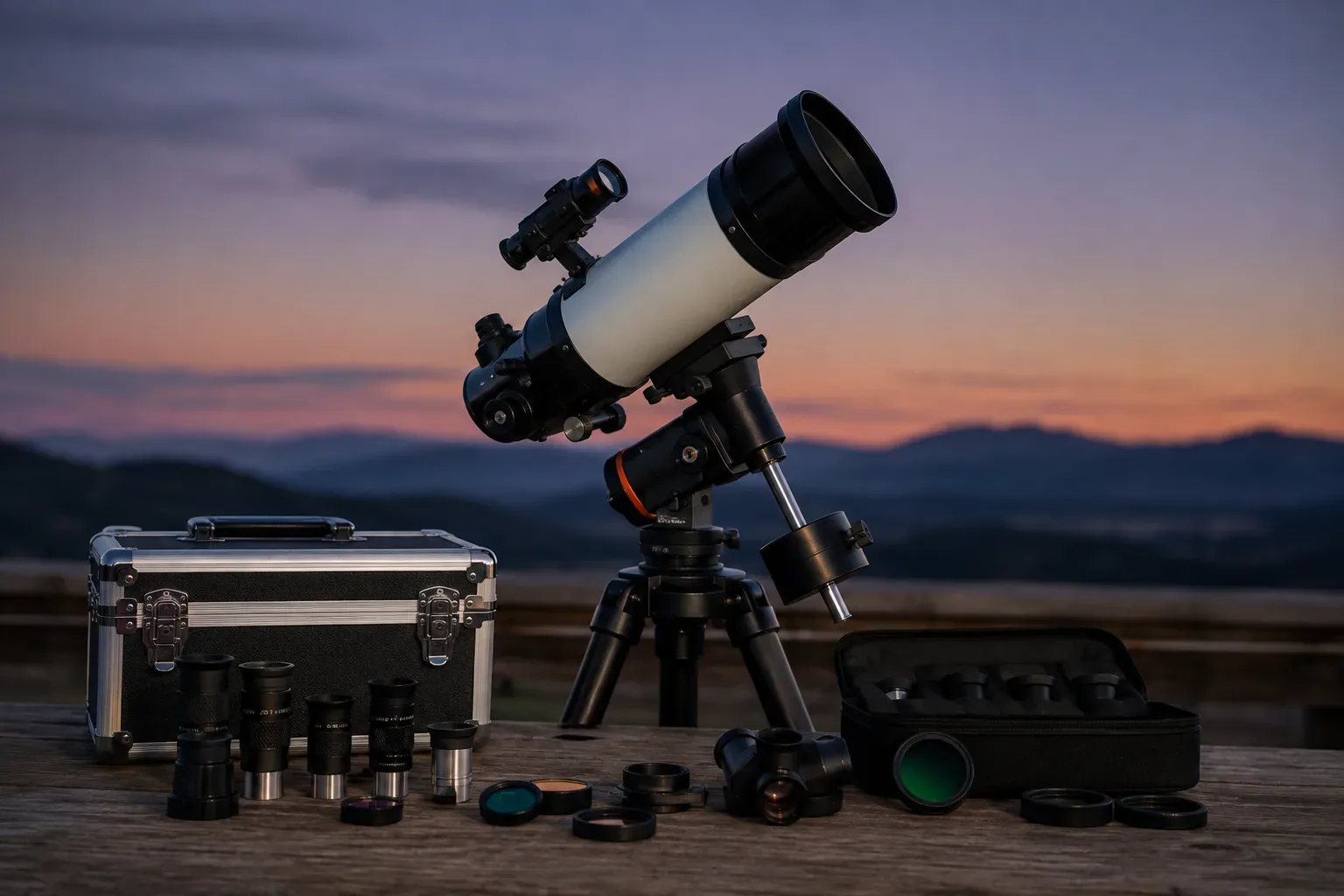
The single best-value accessory: a Barlow lens
A quality 2x Barlow lens sits between the eyepiece and the focuser and effectively doubles your eyepiece collection: a 20mm and a 10mm eyepiece become four usable magnifications instead of two. What separates a good Barlow from a disappointing one is construction, not price alone, look for a metal body and a two-element lens design with multi-coated glass, and skip the single-element plastic Barlows sold in cheap accessory bundles, since they add noticeable distortion.
Should you buy a bundled accessory kit?
Packaged kits, like Celestron's Eyepiece & Filter Kit, bundle a handful of Plössl eyepieces with colored planetary filters at a lower combined price than buying each piece separately. That can be a reasonable starting point if you want variety without researching every individual piece, but it is worth checking the actual eyepiece focal lengths included rather than assuming a kit covers your needs, a kit heavy on similar mid-range focal lengths gives you options that all look alike through the eyepiece, which defeats the point of buying a set.
Telescope camera: useful, but not a first purchase
A telescope camera replaces or supplements your eye at the eyepiece, letting you capture what you see instead of just viewing it. It is also where "digital telescope" and "smart telescope" get confused: a digital telescope generally refers to a traditional optical tube with a camera attachment added on, while a smart telescope is a self-contained, motorized unit with the camera and alignment software built in from the factory. If you are weighing an all-in-one smart telescope instead of accessorizing a traditional scope, our smart telescope guide covers that category separately. For camera options that pair with a telescope you already own, see our astrophotography camera guide.
Do you need a better finder?
The small finder scope or red-dot sight bundled with most telescopes works, but a red-dot finder is faster to aim for wide starfields while a small optical finderscope helps more with precise alignment on faint targets. Neither is essential to replace immediately; it becomes worth upgrading once you notice yourself struggling to locate objects with the stock finder, not before.
Match accessories to your telescope type
Not every accessory matters equally on every design. A Dobsonian or Newtonian reflector needs a collimator sooner or later, since its mirror alignment shifts with transport and handling. A refractor almost never needs collimation, so a second eyepiece is the better early spend. A Schmidt-Cassegrain or Maksutov, with its closed tube, tends to fog on the front corrector plate before an open-tube design does, which makes a dew shield worth prioritizing.
| Telescope type | Accessory to prioritize first |
|---|---|
| Dobsonian / Newtonian reflector | Laser collimator, since mirror alignment drifts with transport and use |
| Refractor | A second eyepiece; refractors rarely need collimation |
| Schmidt-Cassegrain / Maksutov | Dew shield, since the closed tube design is more prone to dew on the corrector plate |
For the full breakdown of each design, see our telescope types overview.
Where to go deeper
This page is a starting map, not the full picture on any single accessory. For eyepiece focal lengths, field of view, and how to calculate magnification, read our eyepiece buying guide. If solar viewing is on your list, the filter requirements are different, and safety-critical, so read solar filters for telescopes before pointing anything at the Sun.
FAQ
What telescope accessories do I actually need as a beginner?
A Moon filter and a second eyepiece solve the two most common first-week frustrations, glare on the Moon and a limited magnification range. A 2x Barlow lens is the next highest-value purchase.
Are Amazon accessory bundle kits worth it?
Bundled kits like Celestron's Eyepiece & Filter Kit can be a reasonable starting point, but check the actual focal lengths included, a set with similar mid-range focal lengths gives less real variety than it looks.
What's the difference between a digital telescope and a smart telescope?
A digital telescope is typically a traditional optical tube with a camera attachment added; a smart telescope is a self-contained motorized unit with camera and alignment software built in.
Do I need a laser collimator?
Only if you own a Newtonian or Dobsonian reflector, refractors and most Schmidt-Cassegrains rarely need it.
When should I buy a telescope camera?
After the basics, a camera is a separate hobby (astrophotography) with its own learning curve, not a first-week purchase.
Sources
- [S001] OPT Telescopes (optcorp.com) : main navigation categories
- [S002] Love the Night Sky : Best Moon Filters, A Complete Guide for Backyard Astronomers
- [S003] TelescopeAdvisor.com : Best Telescope Accessories for Beginners (2026)