
- Key Facts
- Rating6.8/10
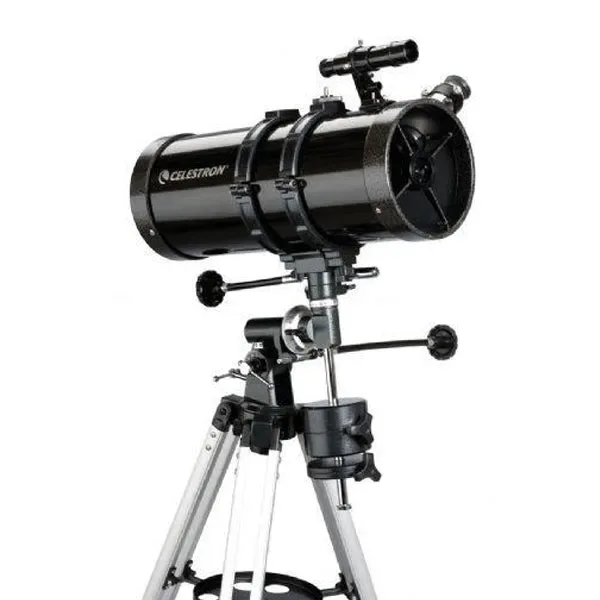
- Why this pick127mm of real aperture, a complete kit (two eyepieces, a Barlow lens, and astronomy software), and a price sold direct from Celestron rather than through a reseller, a genuinely complete first telescope, not a toy.
Pros
- 127mm of real aperture at an entry-level price
- Complete kit included: two eyepieces, a Barlow lens, and astronomy software, nothing extra to buy to get started
- Sold direct from Celestron, not a third-party reseller
Cons
- Fully manual German equatorial mount, no motor drive, takes some getting used to on a first night out
- No GoTo or smartphone guidance, unlike Celestron's own StarSense Explorer line
- 1000mm focal length suits the Moon and planets more than faint deep-sky targets
Most first-time telescope buyers make the same mistake: they shop by magnification number instead of aperture. A box that promises "525x power" sounds impressive next to one that just lists "130mm," but the second telescope will show you a sharper, brighter Saturn every time. This guide covers what actually matters for a first telescope, what you'll realistically spend, and which types hold up best once the novelty wears off.
Aperture decides almost everything else

Aperture is the diameter of a telescope's main lens or mirror. It's the single spec that controls how much light the instrument gathers, and that light is what determines brightness, resolution, and how much fine detail you can actually see. A telescope's aperture also caps how much magnification is worth using. Print "600x" on the box of a 70mm telescope and you'll still be pushing light past its limit; the image just gets dimmer and blurrier as the number climbs. For visual use, the practical guidance is simple: buy the largest aperture your budget and your ability to carry it outside will allow. Six to eight inches is often cited as the sweet spot where the views genuinely improve without the setup becoming a chore.
What beginners actually buy, and what it costs
OPT Telescopes, the retailer most of our recommendations link to, breaks its own beginner lineup into three real price bands. Budget models like the PowerSeeker, AstroMaster, and FirstScope lines run $159 to $229. Mid-range picks, including the SkyScanner and the 8-inch StarSense Explorer Dobsonian, run $399 to $799. Smart, self-aligning telescopes from Unistellar start around $2,999 and climb to $4,899. Most first-time buyers land in the first band, and that's fine: it's enough telescope to see Saturn's rings and Jupiter's moons, just not enough to chase faint galaxies.
One specific option worth naming: the Celestron PowerSeeker 127EQ is a 127mm (5") Newtonian reflector with a 1000mm focal length, sitting on a manual German equatorial mount. It ships with 20mm and 4mm eyepieces, a 3x Barlow lens, and Starry Night software with a 36,000-object database, for $229.95 direct from Celestron. It's a fully capable first telescope for the price, though the manual mount takes a little getting used to (more on that in our budget telescope guide).
If manual pointing sounds like a hassle, Celestron's StarSense Explorer line solves it differently: it uses your phone's camera and an app to figure out exactly where the telescope is aimed and guide you to targets. The entry model, the StarSense Explorer LT 114AZ, currently lists at $239.95 on OPT Telescopes.
Refractor or Dobsonian: the two types worth considering first
| Type | Price level | Ease of use | Best for |
|---|---|---|---|
| Refractor | $159–$399 | Very easy, no collimation needed | Moon and planets, grab-and-go use |
| Dobsonian | $399–$799 for 8" | Simple mount, no tripod needed | Deep-sky objects, most aperture per dollar |
OPT's own beginner guide steers new buyers toward two shapes in particular: refractors like the StarSense Explorer LT 80AZ, and Dobsonian reflectors, which sit on a simple rocker base instead of a tripod and stay noticeably more stable during use. A full breakdown of how every telescope design works, including Schmidt-Cassegrain and Maksutov options, lives in our telescope types guide.
Mistakes that ruin a first telescope
| Mistake | Why it's a problem | What to do instead |
|---|---|---|
| Chasing a big magnification number on the box | Magnification without aperture behind it just produces a dim, blurry image | Check the aperture in mm/inches first, then think about magnification |
| Buying the cheapest tripod-mounted model available | Flimsy mounts vibrate at higher magnification, making planets and the Moon look shaky | Prefer a Dobsonian base or a mount rated for the telescope's weight |
OPT's guide flags both of these directly: shaky tripods that make high-magnification views unusable, and manual mirror alignment (collimation) on some reflectors, which can genuinely frustrate someone on their first night out. Neither is a dealbreaker once you know to check for it before buying.
Browse beginner telescopes at OPT Telescopes /go/opt-telescopes)
Is a GoTo telescope worth it for a first purchase?
A computerized GoTo mount finds and tracks objects automatically once it's aligned, which sounds like an obvious upgrade. In practice, alignment itself is an extra step a total beginner has to learn on a cold night, on top of everything else. Smartphone-guided options like the StarSense Explorer line split the difference: you still point the telescope by hand, but the app tells you exactly which way to move it, so there's no separate alignment ritual to fumble through.
Where to go from here
This page covers the general case. If you're buying specifically for an adult with no kids involved, our best telescope for adults guide narrows the picks further. If price is the deciding factor, our budget telescope guide goes deeper on the PowerSeeker and its closest competitors. And if you already know you want to look at planets specifically, our planet-viewing guide sets realistic expectations for what you'll actually see.