
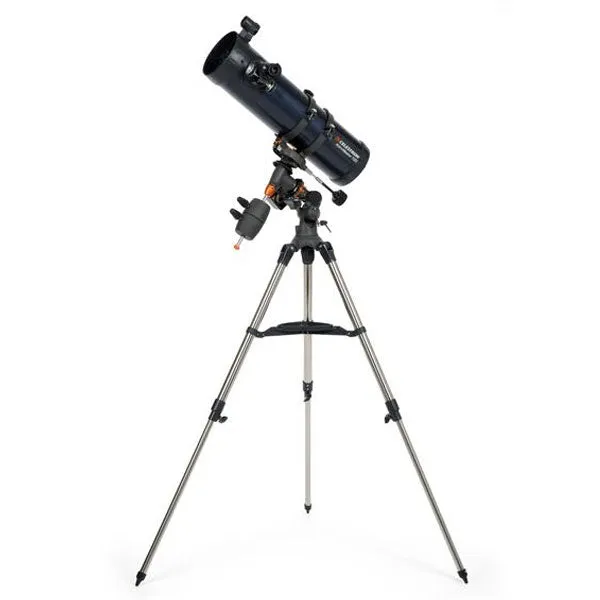
- Key Facts
- Rating7.8/10
- Why this pickThe plain 130EQ and 114EQ require constantly nudging the slow-motion controls by hand to keep an object centered; the MD's built-in motor drive does that automatically on the RA axis, which is the difference between a mount that teaches astronomy and one that's just frustrating for a first-time user.
Pros
- Motor drive removes manual RA tracking, the biggest pain point of the plain 130EQ
- 130mm aperture gathers noticeably more light than the 114EQ or 70AZ
- Same optical tube design across the range, so this upgrade is proven, not experimental
Cons
- Costs about $80–100 more than the non-motorized 130EQ
- Motor drive tracks one axis only, no full GoTo automation
- Setup and polar alignment still take longer than an alt-azimuth mount
Celestron sells three telescopes under the AstroMaster name, and they're built differently enough that "which AstroMaster" is a real question, not a formality. The 70 is a refractor on a simple mount. The 114 and 130 are reflectors on equatorial mounts. Here's what separates them and what each size actually costs.
AstroMaster 70 vs. 114 vs. 130
| Model | Optical Design | Aperture | Mount Type | Weight | Price | Best For |
|---|---|---|---|---|---|---|
| AstroMaster 70AZ | Refractor | 70mm (2.76") | Manual alt-azimuth | 10.8 lbs | $199.95 | Simplest setup, no polar alignment needed |
| AstroMaster 114EQ | Newtonian reflector | 114mm (4.48") | Manual German equatorial (CG-2) | 13.3 lbs | $329.95 | More aperture, willing to learn EQ mount |
| AstroMaster 130EQ | Newtonian reflector | 130mm (5.11") | CG-3 equatorial | 17 lbs | $359.95 | Most light-gathering power in this lineup |
AstroMaster 70AZ: A Refractor, and the Only Alt-Azimuth Option
The 70AZ is the odd one out in this lineup. It's a refractor, using a lens instead of a mirror, and it sits on a manual alt-azimuth mount that moves up-down and left-right like a camera tripod. No polar alignment step, no learning curve beyond pointing it where you want to look. At 70mm (2.76") aperture and 900mm focal length (f/13), it's the smallest and lightest scope of the three at 10.8 lbs total, and the cheapest at $199.95. It ships with 20mm and 10mm eyepieces, an erect-image star diagonal, a StarPointer finderscope, and Starry Night Basic software.
AstroMaster 114EQ and 130EQ: Reflectors on Equatorial Mounts
The 114 and 130 switch to Newtonian reflector optics with spherical primary mirrors, mounted on manual German equatorial mounts. That's a real trade for more aperture: 114mm and 130mm respectively, versus 70mm on the refractor. It also means a genuine learning step, since an equatorial mount needs polar alignment to track objects properly, something the 70AZ's alt-azimuth design skips entirely. The 130EQ's f/5 focal ratio gives it the widest field of view in the series and the highest rated useful magnification at 307x, against 269x for the 114EQ.
Choosing Between the Three
For someone who wants to start observing the first night with zero setup friction, the 70AZ's alt-azimuth mount removes that barrier at the cost of aperture. For someone willing to spend an evening learning polar alignment in exchange for more light-gathering power, the 114EQ or 130EQ deliver noticeably more detail on deep-sky targets. Between the two reflectors, the 130EQ costs $30 more than the 114EQ for 16mm more aperture and a faster focal ratio, a reasonable trade if the extra $30 fits the budget.
If a manual equatorial mount at this price point sounds like a hassle rather than a feature, Celestron's PowerSeeker 127EQ sits in similar territory at a lower price, with different trade-offs worth reading about before deciding between the two lines.