
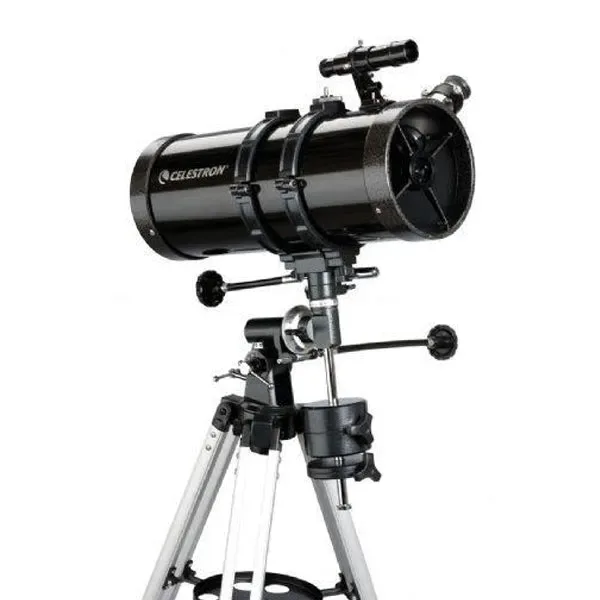
- Key Facts
- Rating7/10
- Why this pickAt $189.95 it undercuts the AstroMaster 114EQ by roughly $150 while offering a larger 127mm aperture, the trade-off is a lighter, less rigid mount that needs a gentle touch, which is why it suits a first telescope for someone testing the hobby rather than a buyer chasing planetary detail.
Pros
- Lowest price of any 127mm reflector we cover
- Equatorial mount teaches real tracking, not just point-and-look
- 3x Barlow lens adds real versatility to the included eyepieces
- Confirmed in stock and shipping free at OPT Telescopes
Cons
- Lightweight mount flexes noticeably at higher magnifications
- No motor drive, tracking is entirely manual
- Included eyepieces are basic; most owners upgrade within the first year
The PowerSeeker 127EQ is one of the most-searched telescope models by name in this dataset, ahead of every other individual model besides Celestron's own NexStar 8SE. At $229.95, it's positioned as an affordable first "real" telescope. Whether it deserves that spot depends on what you're comparing it to.
PowerSeeker 127EQ Specs
| Spec | Value |
|---|---|
| Optical design | Newtonian reflector, spherical primary mirror |
| Aperture | 127mm (5") |
| Focal length / ratio | 1000mm / f/7.87 |
| Mount | Manual German equatorial |
| Total weight | 13 lbs (5.9 kg) |
| Price (Celestron MSRP) | $229.95 |
| Included accessories | 20mm + 4mm eyepieces, 5x24 finderscope, 3x Barlow lens |
What This Telescope Actually Delivers
At 127mm (5") of aperture, the 127EQ collects noticeably more light than the 60-90mm refractors that fill out the low end of the market. Celestron rates it for 300x maximum useful magnification and 329x the light-gathering power of the naked eye. That's enough to show Saturn's rings, cloud bands on Jupiter, lunar craters in real detail, and a handful of the brighter deep-sky objects under a dark sky. It's a real telescope, not a toy, the spherical primary mirror is the honest caveat here, a cheaper design than the parabolic mirrors used on pricier reflectors, and it's the main reason this model sits at $229.95 instead of $350+.
The Mount Is the Real Learning Curve
The included accessories tell most of the story: a 20mm eyepiece, a 4mm eyepiece, a 3x Barlow lens, and a manual German equatorial mount with slow-motion RA/DEC knobs. Stack the 3x Barlow onto the 4mm eyepiece and you're pushing magnification well past what a 127mm mirror can cleanly resolve, that combination is better left in the box for casual use. The equatorial mount itself is the bigger adjustment for a first-time buyer used to point-and-look designs: it needs to be polar-aligned to track properly, and that alignment step is unfamiliar territory for most people buying their first telescope. Budget an evening to learn it before writing off the scope.
Is It Better Than the AstroMaster?
Celestron also sells the AstroMaster series at a similar price point, and the two get compared constantly. The short version: the AstroMaster 114EQ and 130EQ use the same equatorial mount concept but with a parabolic primary mirror, and the AstroMaster 70AZ swaps to a simpler alt-azimuth mount for buyers who want to skip polar alignment entirely. Our full AstroMaster comparison breaks down which size fits which budget.
Verdict: Is the PowerSeeker 127EQ Worth Buying?
Buy it if $229.95 is your ceiling and you're willing to spend an evening learning to polar-align an equatorial mount. The 127mm aperture is real and does more than the toy-store telescopes that share shelf space with it.
Skip it if you want to start observing the same night you unbox the scope. The AstroMaster 70AZ's alt-azimuth mount is simpler to use out of the box, even though it trades away some aperture. See our budget telescope picks for other options at this price.