
Short answer: for most people who want real astrophotos without learning to collimate a mirror or polar-align a mount, yes. The Seestar S50 is the single most-searched product in this entire site's dataset, 9,900 monthly searches on the bare name alone, more than most full telescope brands combined F001. That volume comes from people who've already seen the photos it produces online and want to know if the hype holds up.
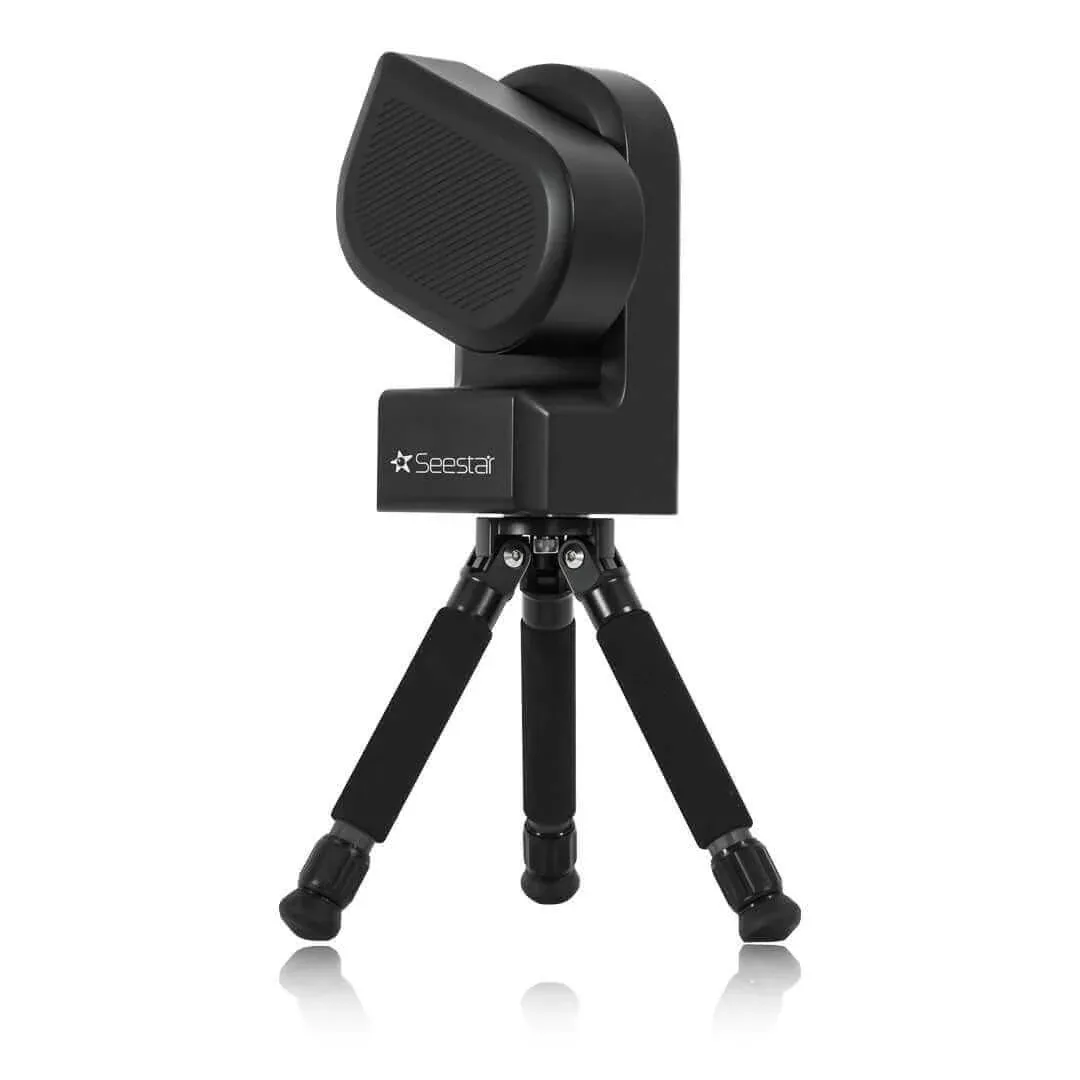
What the Seestar S50 actually is
It's a 50mm apochromatic refractor with a 250mm focal length (f/5), but describing it that way undersells what ZWO built. The tube houses a Sony IMX462 sensor, an electric focuser, Wi-Fi and Bluetooth radios, an alt-azimuth GoTo mount, a built-in dew heater, and a dual-band light-pollution filter (OIII 30nm / H-alpha 20nm), all controlled from a phone app, with no separate mount, laptop, or guide camera required F001. You point your phone at the sky, tap a target, and the S50 finds it, tracks it, and stacks exposures automatically.
Is it worth the price?
At $549 from ZWO directly, the S50 costs less than a decent DSLR lens, let alone a traditional astrophotography rig (telescope + mount + camera + guide scope routinely runs past $2,000). The trade-off is resolution and aperture: 50mm will never out-resolve a 6-inch Newtonian on a tracking mount, and the 1920x1080 sensor caps how much detail you can pull out of a stacked image F001. What you're paying for is the fact that it works the first night, out of the box, with a nine-year-old or a total beginner operating it.
Battery life is the real-world limiting factor: ZWO rates the internal 6,000mAh pack at about six hours, less with the dew heater running on a cold or humid night. That's enough for one full observing session but not an all-nighter, plan to bring a USB-C power bank if you're chasing a specific object that only clears the horizon late.
Where to actually get one
This is the part most reviews skip. As of this research (2026-08-20), ZWO's own store lists the S50 as out of stock at $549 F008. Neither of the two US merchants this site works with carries it either: OPT Telescopes' search returns zero results for "seestar," and Explore Scientific's smart-telescope category lists Dwarf Lab and Unistellar products but no ZWO Seestar line, despite OPT stocking ZWO's separate astrophotography cameras F008. If you're set on buying one, check ZWO's official store and major camera retailers directly for current stock rather than assuming any specific seller has it.
Seestar S50 vs Seestar S30: which one should you buy?
The S50 isn't ZWO's only smart telescope. The S30 starts at $399 and the S30 Pro runs $699–$888, meaning the S50 sits in the middle of ZWO's own lineup, not at the top. If budget is the deciding factor, our Seestar S30 review covers exactly how much you give up for the $150 savings, since "dwarf 3 vs seestar s50" and S30-vs-S50 comparisons are two of the most common searches people run before buying either one.
Seestar S50 vs Dwarf 3
The Dwarf 3 is the S50's closest real competitor at the same $549 price point, but it takes a different approach: a dual-lens system (a 737mm-equivalent telephoto lens plus a wide 45mm lens) instead of a single fixed-aperture tube, which makes it more of a hybrid day/night camera than a dedicated astronomy instrument. Our Dwarf 3 review breaks down which use case fits which device.
| Spec | Value |
|---|---|
| Aperture | 50mm apochromatic triplet (ED glass) F001 |
| Focal length / ratio | 250mm, f/5 F001 |
| Sensor | Sony IMX462, 1920x1080 |
| Battery | 6,000mAh, ~6 hours |
| Weight | 2.5 kg |
| Price (ZWO official) | $549 F008 |
Can you use it in a light-polluted city?
Yes, this is arguably the S50's biggest selling point over a traditional telescope. The built-in dual-band filter blocks most of the sodium and mercury-vapor wavelengths that streetlights emit, letting the sensor pick out OIII and H-alpha emission from nebulae that would be invisible to the naked eye from a backyard in most suburbs. It won't match a dark-sky site, but it makes deep-sky imaging realistic for people who can't drive two hours to escape light pollution every time they want to observe.
Verdict
Buy the Seestar S50 if you want real nebula and galaxy photos with minimal setup time and don't mind a modest sensor resolution. Skip it if you already own a tracking mount and want to grow into traditional astrophotography with interchangeable optics, or if you specifically need the S50 today and can't find current stock, in which case the S30 (see below) or Dwarf 3 are worth checking as in-stock alternatives.
FAQ
Is the ZWO Seestar S50 good for a beginner?
Yes, it's built specifically to remove the setup and alignment steps that make traditional astrophotography hard for beginners, at the cost of some resolution and aperture compared to a dedicated rig F001.
How long does the Seestar S50 battery last?
About six hours on a full charge, less if the built-in dew heater is running in cold or humid conditions.
Where can I buy a ZWO Seestar S50 in the US?
As of this research, neither OPT Telescopes nor Explore Scientific, the merchants this site works with, currently stock it, and ZWO's own store lists it as out of stock. Check ZWO's official store and major camera retailers directly for current availability F008.
Is the Seestar S50 better than the Seestar S30?
The S50 has a larger 50mm aperture versus the S30's smaller optics, for $150 more. See our dedicated Seestar S30 review for the full comparison.
Is the Seestar S50 or the Dwarf 3 the better buy?
They're priced identically at $549 but solve different problems: the S50 is a purpose-built deep-sky imager, while the Dwarf 3's dual-lens design adds daytime and wide-field versatility. See our Dwarf 3 review for the full breakdown.
Sources
- [F001] ZWO : Seestar S50 official product page
- [F008] OPT Telescopes search + Explore Scientific smart-telescope category :
- [S004] dataset/site-architecture.json : best-telescope (volumes SEMrush réels)