- Key Facts
- Rating7.8/10
- Why this pickAt 23 lbs total and with SkyAlign auto-alignment, the 4SE trades some aperture for genuine portability and a hands-off GoTo experience, for buyers who want the NexStar computer without committing to the size and cost of the flagship 8SE, this is the realistic starting point.
Pros
- SkyAlign gets you tracking objects within minutes, no manual star-hopping
- Compact and light enough for one-trip setup, unlike the 8SE
- 40,000+ object database via the NexStar hand controller
Cons
- 102mm aperture is modest next to the 130SLT or 8SE for deep-sky detail
- Runs through AA batteries quickly without the optional AC or WiFi power accessory
- Costs roughly $200 more than the manual StarSense Explorer DX 130AZ for less aperture
The NexStar 8SE gets most of the attention as Celestron's flagship, but it's not where most buyers start. The 4SE, 5SE and 130SLT sit below it, and between the three of them the naming gets confusing fast, "SE" and "SLT" sound like minor suffixes, but they describe genuinely different telescopes.
What "SE" and "SLT" Actually Mean
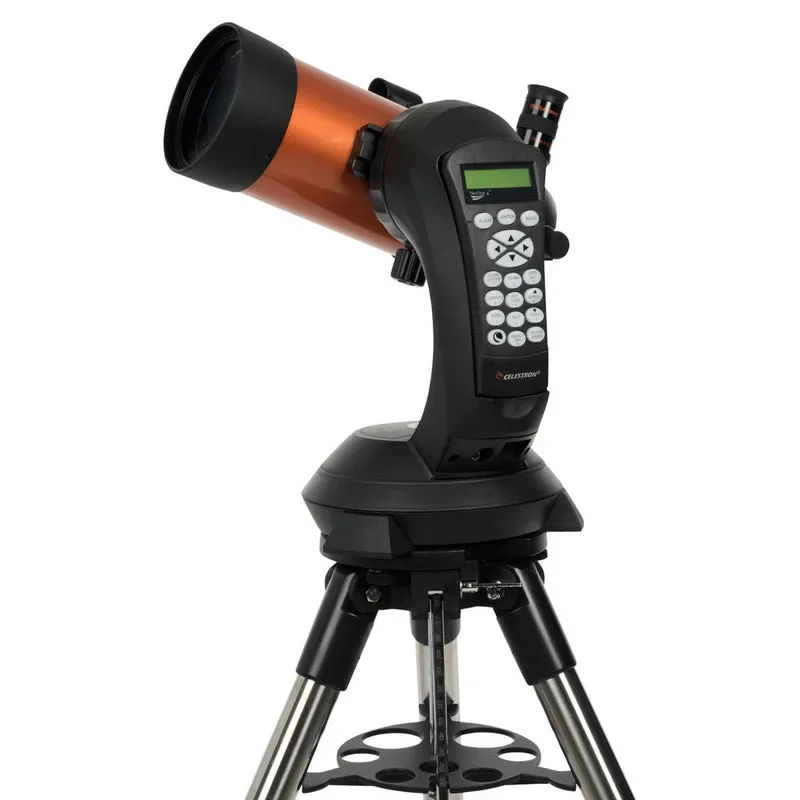
The NexStar 4SE is a 102mm Maksutov-Cassegrain on a computerized single-fork-arm mount, with a focal length of 1325mm at f/13. It's motor-driven, with 9 slew speeds up to 3 degrees per second, and tracks at sidereal, solar and lunar rates. The 5SE shares that same electronics and mount design, just with a larger aperture, around 5 inches (127mm), that pulls in more light and reveals fainter deep-sky detail than the 4SE.
The 130SLT is a different animal entirely. It's a 130mm Newtonian reflector, not a Maksutov-Cassegrain, at f/5 with a 650mm focal length, on a single-arm motorized alt-azimuth mount. The SE and SLT designations aren't a quality tier, they describe different optical designs and mount styles. SE models are compact fork-arm Maksutov-Cassegrains; SLT models pair Celestron's motorized single-arm mount with a Newtonian tube or refractor.
| Model | Optical Design | Aperture | Mount | Price Tier | Best For |
|---|---|---|---|---|---|
| NexStar 4SE | Maksutov-Cassegrain | 102mm | Computerized fork-arm alt-az | $749 | Compact GoTo entry point, Moon and planets |
| NexStar 5SE | Maksutov-Cassegrain | ~127mm | Same design as 4SE, larger optics | Higher than the 4SE, exact price not confirmed | Fainter deep-sky detail than the 4SE, identical electronics |
| NexStar 130SLT | Newtonian reflector | 130mm | Single-arm motorized alt-az | Not confirmed | More aperture for the money, Newtonian rather than catadioptric optics |
What You Get With the 4SE
The 4SE is the only model in this trio with a fully public spec sheet, which makes it the easiest to evaluate concretely. The kit includes the optical tube, mount and tripod, an accessory tray, a StarPointer finderscope, a built-in wedge, the NexStar+ hand control, a 25mm eyepiece, and bundled Starry Night software plus the SkyPortal app. It weighs 23 lbs total and breaks down into separate, transportable pieces. Celestron prices it at $749 with free ground shipping in the contiguous US, and it's confirmed listed by OPT Telescopes.
Alignment runs through Celestron's SkyAlign system, which only needs three bright objects in view, you don't have to identify them by name, plus 1-star, 2-star and Auto 2-Star options if you'd rather align manually. Once set up, the database holds 38,181 accessible objects.
4SE, 5SE, or Save for the 8SE?
If a compact Maksutov-Cassegrain that sets up quickly and travels easily matters more to you than raw light-gathering, the 4SE is the more sensible buy at $749. If you're already committed to the SE line and can stretch the budget, the 5SE's larger aperture is a meaningful upgrade for the same interface and mount you'd already be learning on the 4SE. Neither is close to the 8SE in aperture, for readers ready to spend more for real light-gathering power, our NexStar 8SE review covers Celestron's actual flagship in this family.
The 130SLT is the odd one out here: it trades the compact Maksutov-Cassegrain tube for a Newtonian reflector on a similar motorized mount, at a lower likely cost per inch of aperture. It's worth considering specifically if a Newtonian's wider field of view matters more to you than the Maksutov-Cassegrain's compact, high-magnification design.
None of these three motorized models are the only way to get GoTo-style convenience from Celestron. If a fully manual, phone-guided alternative sounds more appealing, no motor to maintain, lower entry price, our StarSense Explorer review covers that side of the lineup.